Want to Sell Keith Haring Dog Series Lithographs? Although collectors and gallery indexes frequently search for these works as the “Dog Series” or “Dog screenprints,” they are not a single formal portfolio—and the primary editions on paper are black-and-white lithographs rather than screenprints. Send us clear photographs of your Keith Haring artwork for a confidential evaluation and a potential direct purchase offer.
Contact Us About Selling Your Keith Haring
Year
1982 & 1985–1987
Artworks
5 Grouped Lithographs
Edition Size
40 + 8 AP / 40 + 10 AP
Signature
Hand-Signed in Red Pencil
Why the “Dog Series” Is a Subject Grouping Rather Than a Single Portfolio
Keith Haring never published a formal portfolio titled the Dog Series. Instead, secondary-market databases and gallery directories group five black-and-white lithographs together under this label because they share Haring’s recurring canine and human-dog hybrid iconography. In Klaus Littmann’s catalogue raisonné (Keith Haring: Editions on Paper 1982–1990), these five works come from two separate publications issued years apart by different publishers.
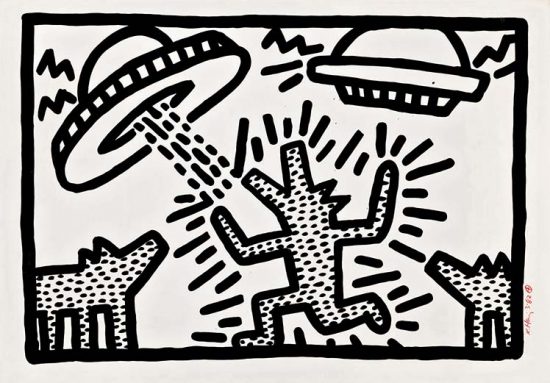
The first work is Haring’s monumental vertical lithograph Dog (1985–1987, Littmann pp. 48–49), published by Edition Schellmann, which fills an Anubis-like standing dog contour with dense interior scenes (and was also issued in 1986 as a painted plywood multiple with screenprint). The other four works—Untitled (Plate 2), Untitled (Plate 3), Untitled (Plate 4), and Untitled (Plate 5)—are horizontal lithographs from Haring’s very first editioned suite of six untitled lithographs (1982, Littmann pp. 18–21), published by Barbara Gladstone Editions, New York, depicting barking dogs and dog-headed figures alongside crosses, television sets, and UFOs.



Editions, Proofs, and Signatures
Because the works grouped under the Dog Series belong to two distinct releases, edition proofs and dates differ between the 1982 plates and the 1985–1987 standalone Dog edition:
Untitled (Plates 2, 3, 4, and 5), 1982 (Littmann pp. 18–21)
Published by Barbara Gladstone Editions, New York, each plate from the six-part 1982 Untitled suite was issued in an edition of 40 plus 8 Artist’s Proofs (AP). Impressions are lifetime hand-signed, dated (often 3.82 or 82), and numbered in red pencil or red crayon in the lower right margin.
Dog, 1985–1987 (Littmann pp. 48–49)
Published by Edition Schellmann, Munich and New York, the large vertical Dog lithograph was produced in an edition of 40 numbered in Arabic numerals (1/40–40/40) plus 10 Artist’s Proofs numbered in Roman numerals (AP I/X–AP X/X). Impressions are hand-signed, dated (typically 86), and numbered by Haring in red pencil in the lower right. Edition Schellmann also released a companion 1986 painted plywood multiple with screenprint in a signed and numbered edition of 10.
Paper, Dimensions and Production Details
The 1982 Barbara Gladstone Untitled lithographs were printed on Arches wove paper measuring approximately 24 × 36 inches (61 × 91 cm; auction sheets up to 25 1/4 × 36 1/4 inches). The 1985–1987 Edition Schellmann Dog grano-lithograph was printed on heavy BFK Rives rag paper measuring approximately 45 × 35 1/2 inches (114 × 90 cm).
Curious how signature legibility, sheet condition, provenance, and edition type factor into current market pricing? Read our How Much Is My Keith Haring Worth? value guide.
How to Sell Your Keith Haring Dog Artwork
1. Send Photographs
Submit clear photos of the full front, the reverse (or framing backing), and a close-up of the red-pencil signature, date, and edition number in the lower right.
2. Share Artwork Details and Ownership Records
Let us know which composition you own—whether the vertical 1985–1987 Dog or one or more plates from the 1982 Untitled set—along with dimensions and any invoices or gallery labels.
3. Discuss Potential Purchase
We evaluate the specific artwork confidentially and, if it fits our current acquisition interests, make a straightforward direct purchase offer without auction delays or consignment fees.
Frequently Asked Questions
Is the Keith Haring “Dog Series” an official portfolio?
No. “Dog Series” (or “Dogs Series”) is a gallery and market classification rather than a title assigned by Keith Haring. It combines the standalone 1985–1987 Dog edition published by Edition Schellmann with the four canine-themed plates (Plates 2, 3, 4, and 5) from Haring’s six-part 1982 Untitled lithograph portfolio published by Barbara Gladstone Editions.
Are these Dog Series works screenprints or lithographs?
All five paper editions shown in this grouping—the 1985–1987 Dog (Littmann pp. 48–49) and the 1982 Untitled plates (Littmann pp. 18–21)—are black-and-white lithographs, not screenprints. However, Edition Schellmann did produce a companion 1986 Dog multiple in painted plywood with screenprint, and Haring’s later 1990 Barking Dog from the Icons portfolio is an embossed screenprint.
Can I sell a single 1982 Untitled plate, or do I need the complete set of six?
We evaluate and purchase both individual plates—such as Untitled (Plate 2), Untitled (Plate 3), Untitled (Plate 4), or Untitled (Plate 5)—and complete sets of the 1982 Barbara Gladstone portfolio.
Why are the red signatures on 1982 and 1985–1987 lithographs sometimes faded?
Haring signed and numbered both the 1982 Untitled lithographs and the 1985–1987 Dog lithograph in red pencil or crayon. Because red pigment is susceptible to light exposure over time, slight attenuation is common on framed examples and is carefully reviewed during our evaluation.
Ready to Evaluate Your Keith Haring Dog Artwork?
Send photographs and details of your 1985–1987 Dog edition or 1982 Untitled lithograph for a confidential review and potential direct purchase offer.