


Want to Sell Keith Haring Apocalypse Screenprints? Send us clear photographs and details of your individual 1988 screenprint or complete portfolio with William S. Burroughs text panels for a confidential evaluation and a potential direct purchase offer.
Contact Us About Selling Your Keith Haring
Year
1988
Artworks
10 Screenprints
Edition Size
90 + 20 AP + 5 HC
Signature
Hand-Signed in Pencil
Apocalypse Series Overview and All 10 Compositions
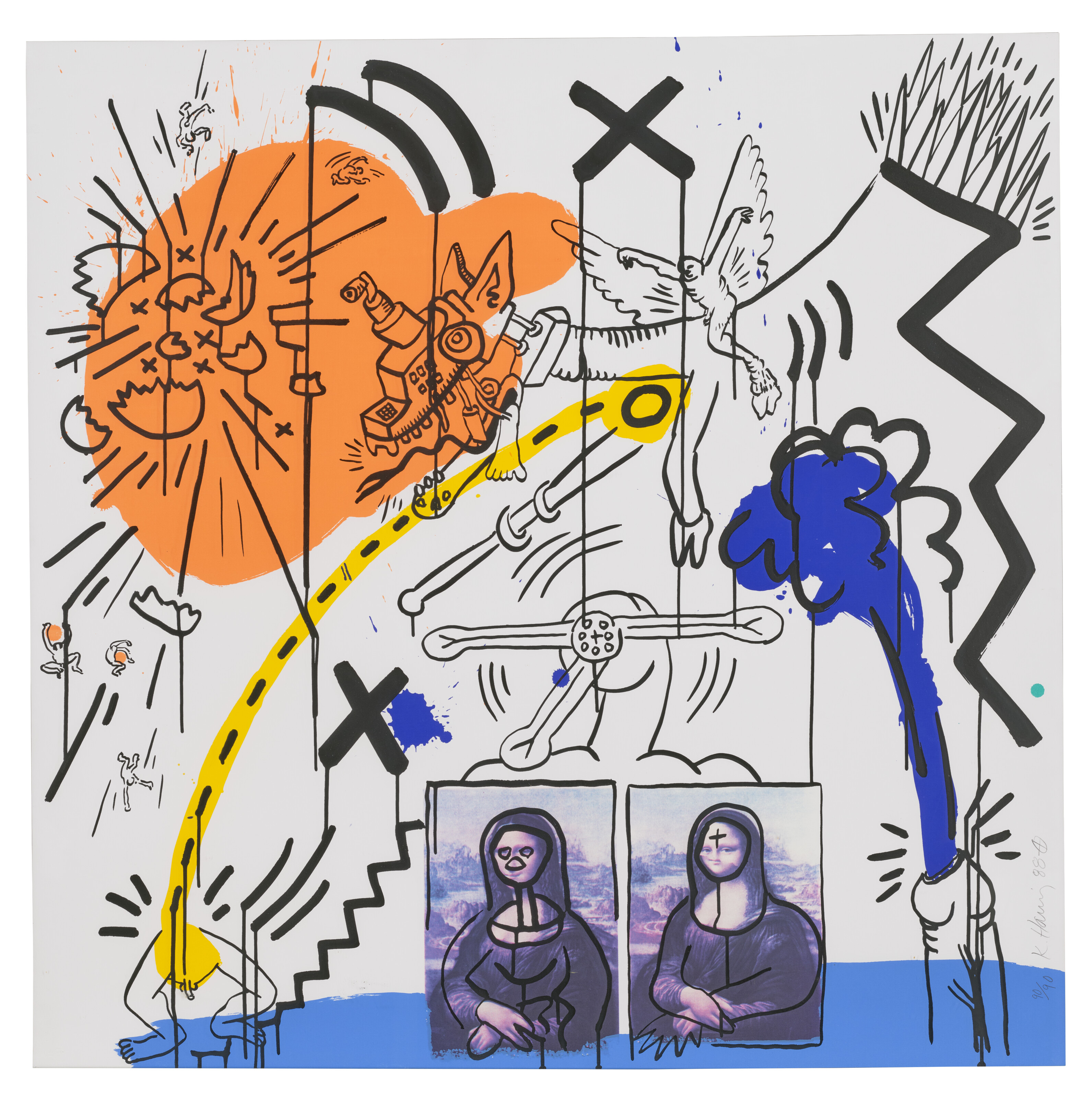
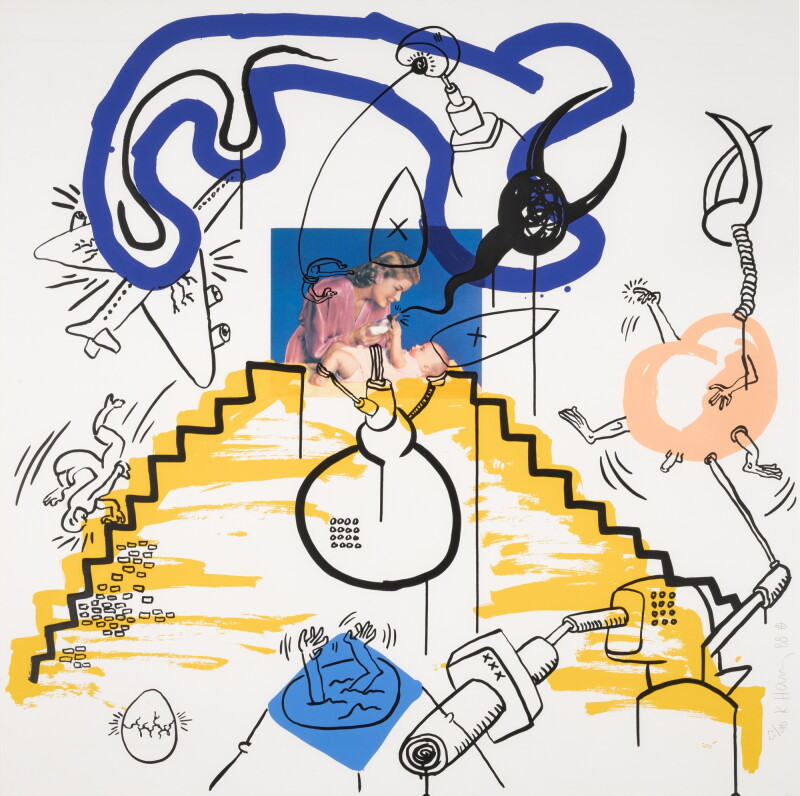
Created in 1988—the same year Keith Haring was diagnosed with AIDS—Apocalypse (documented in Klaus Littmann’s catalogue raisonné on pages 98–109) is a collaborative portfolio between Haring and Beat writer William S. Burroughs. Inspired by Burroughs’s cut-up literary technique, Haring combined his graphic linework with simulated collage elements, historical religious imagery, anatomical motifs, daggers, serpents, burning cityscapes, and radiant figures to confront themes of mortality, illness, religious dogma, and modern upheaval.
The complete portfolio pairs 10 large square color screenprints on Museum Board by Keith Haring with 10 accompanying verses by William S. Burroughs screenprinted on semi-transparent PVC acetate sheets (along with a title page and colophon), housed in an original PVC portfolio case.



Editions, Proofs, and Signatures
Each of the 10 screenprints in the 1988 Apocalypse suite (Littmann pp. 98–109) was published in a numbered edition of 90 (1/90–90/90), plus 20 Artist’s Proofs (AP) and 5 Hors Commerce (HC) impressions. Every visual plate is lifetime hand-signed, dated (88), and numbered by Keith Haring in pencil, with master printer Rupert Jasen Smith’s blindstamp impressed in the sheet.
In complete portfolios, the accompanying colophon/introduction and PVC acetate text sheets carry William S. Burroughs’s signature. When evaluating a single plate or a full set, we review both the pencil inscription on the Museum Board screenprint and whether any original Burroughs text overlays or portfolio casing remain with the work.
Paper, Dimensions and Production Details
Published by George Mulder Fine Arts, New York, and printed by master screenprinter Rupert Jasen Smith, New York (with his blindstamp), each Apocalypse image was screenprinted in colors on heavy wove Museum Board measuring 38 × 38 inches (96.5 × 96.5 cm), accompanied in full sets by 38 × 38 inch screenprinted PVC acetate text sheets.
Curious how individual plate subject matter, surface condition, signature legibility, and complete-portfolio documentation affect market value? Read our How Much Is My Keith Haring Worth? value guide.
How to Sell Your Keith Haring Apocalypse Screenprint
1. Send Photographs
Send clear photographs of the front and reverse of each screenprint, plus close-ups of Keith Haring’s pencil signature, date, edition number, and the Rupert Jasen Smith blindstamp.
2. Share Artwork Details and Ownership Records
Indicate which plate(s) you own (Plates 1 through 10), whether the accompanying William S. Burroughs acetate text sheet or portfolio box is included, and share any gallery invoices or provenance records.
3. Discuss Potential Purchase
We evaluate your individual plate or complete suite confidentially and, for works we are actively seeking, extend a direct purchase offer without auction delays or seller commissions.
Frequently Asked Questions
Can I sell an individual Keith Haring Apocalypse screenprint without the William S. Burroughs acetate text sheet?
Yes. Individual Apocalypse screenprints on Museum Board are frequently framed and traded separately from the PVC acetate text overlays, and we evaluate and purchase both standalone plates and complete portfolios.
Are the collage elements in the Apocalypse series hand-glued or screenprinted?
Although Haring composed the maquettes using cut-and-pasted magazine clippings, art-historical reproductions, and drawings, the final 1988 editions were executed entirely as multi-color screenprints by printer Rupert Jasen Smith on 38 × 38 inch Museum Board.
What proof impressions exist for the 1988 Apocalypse portfolio?
Alongside the standard numbered edition of 90 (1/90–90/90), documented catalogue and auction records list 20 Artist’s Proofs (AP 1/20–20/20) and 5 Hors Commerce impressions (HC 1/5–5/5), each signed and dated in pencil.
What condition details are most important on Apocalypse screenprints?
Because the Apocalypse plates are printed to the edges or with full saturated color fields on heavy 38 × 38 inch Museum Board, we look closely at corner sharpness, surface scuffs or craquelure in dense ink areas, color vibrancy, and how the board is mounted inside the frame.
Ready to Evaluate Your Keith Haring Apocalypse Screenprint?
Send photographs and details of your 1988 Apocalypse screenprint or complete portfolio for a confidential review with our gallery owners.