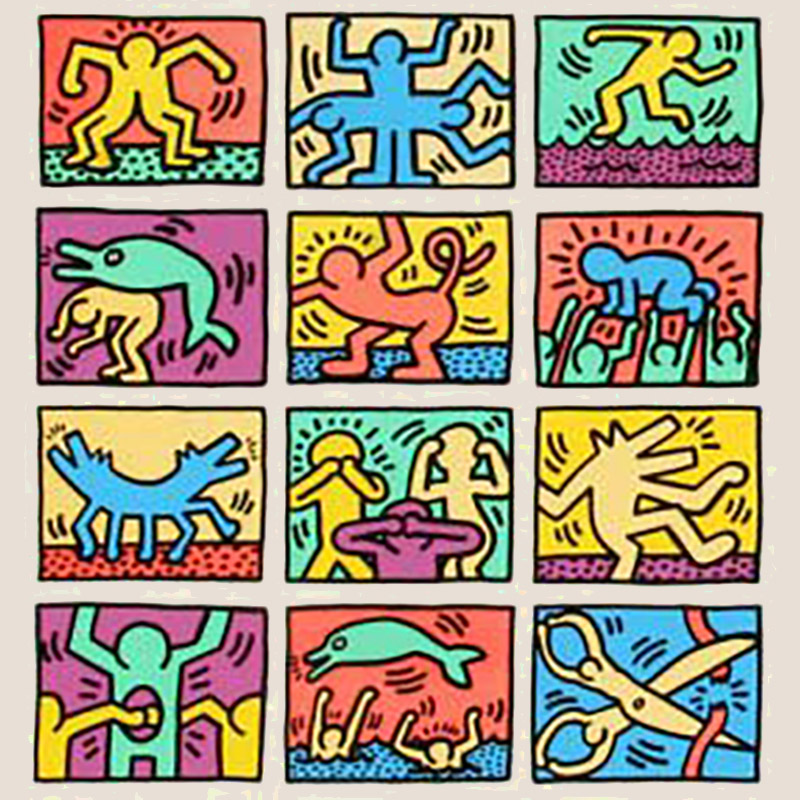




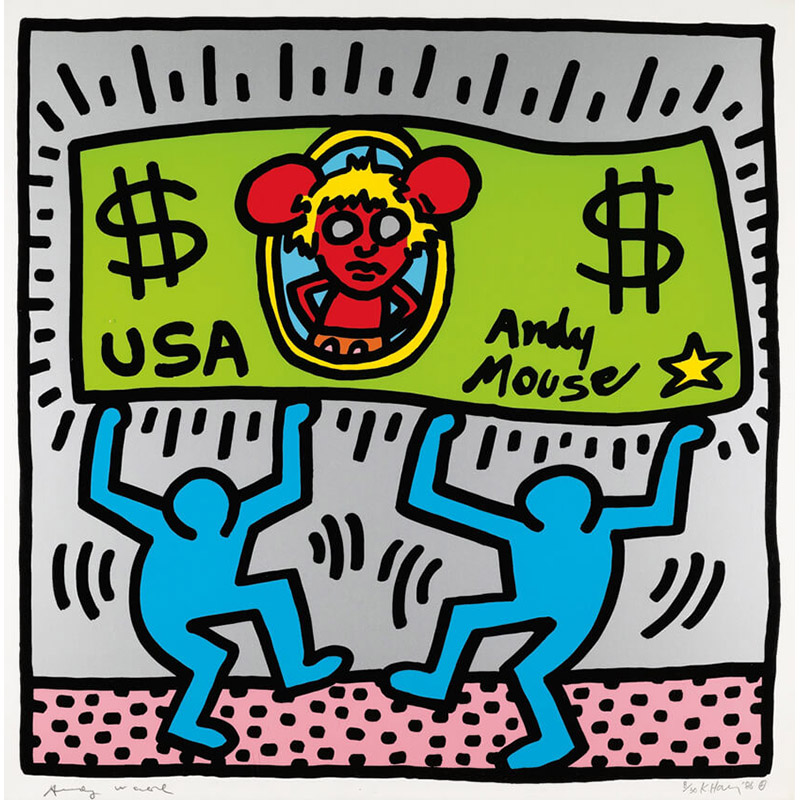
Want to Sell Keith Haring Pop Shop Screenprints? Our gallery reviews individual screenprints, complete portfolios from Pop Shop I–VI and Pop Shop Quad editions for potential direct purchase. We consider the exact image, edition, signature or estate certification, condition and ownership history.
Start with clear photographs. The familiar figures can appear across several formats, so identifying the specific screenprint is the first step toward understanding its value.
Request a Free Pop Shop Valuation
Keith Haring’s Pop Shop Series
Haring opened the original Pop Shop in New York in 1986 as a way to bring his imagery to a wider audience. The screenprint portfolios share its accessible visual language: bold outlines, bright color and figures that embrace, dance and connect.
Explore All Six Pop Shop Portfolios
Pop Shop I–VI each contain four different compositions. Together, the six portfolios comprise 24 images, with all four compositions from each portfolio shown below. The portfolio number, palette, sheet dimensions and markings help establish which screenprint you own.
Pop Shop I — 1987
The first Pop Shop portfolio brings together interacting human figures in purple, turquoise, yellow and orange, bounded by Haring’s thick black outlines. Its four compositions include figures supporting one another, embracing and connecting through an opening in a larger figure’s body.
Format: Four separate screenprints, generally on sheets around 12 × 15 inches.
Edition: 200 numbered impressions per image, plus proofs.
Markings: Generally signed, dated and numbered by Haring in pencil.


Pop Shop II — 1988
Pop Shop II uses blue, pink and ochre to explore movement and unexpected combinations of the human body. The four compositions include a figure with two joined lower bodies, backbending forms and figures balanced above water. Match the exact composition as well as the palette.
Format: Four separate screenprints, generally on sheets around 12 × 15 inches.
Edition: 200 numbered impressions per image, plus proofs.
Markings: Generally signed, dated and numbered by Haring in pencil.


Pop Shop III — 1989
Red, yellow and teal figures stand against gray backgrounds in Pop Shop III. One composition shows three figures covering their eyes, ears and mouth; another depicts scissors cutting a cord. Record the full sheet dimensions, since photographs and frame openings can conceal the surrounding margins.
Format: Four separate screenprints, generally on sheets around 13½ × 16½ inches.
Edition: 200 numbered impressions per image, plus proofs.
Markings: Generally signed, dated and numbered by Haring in pencil.
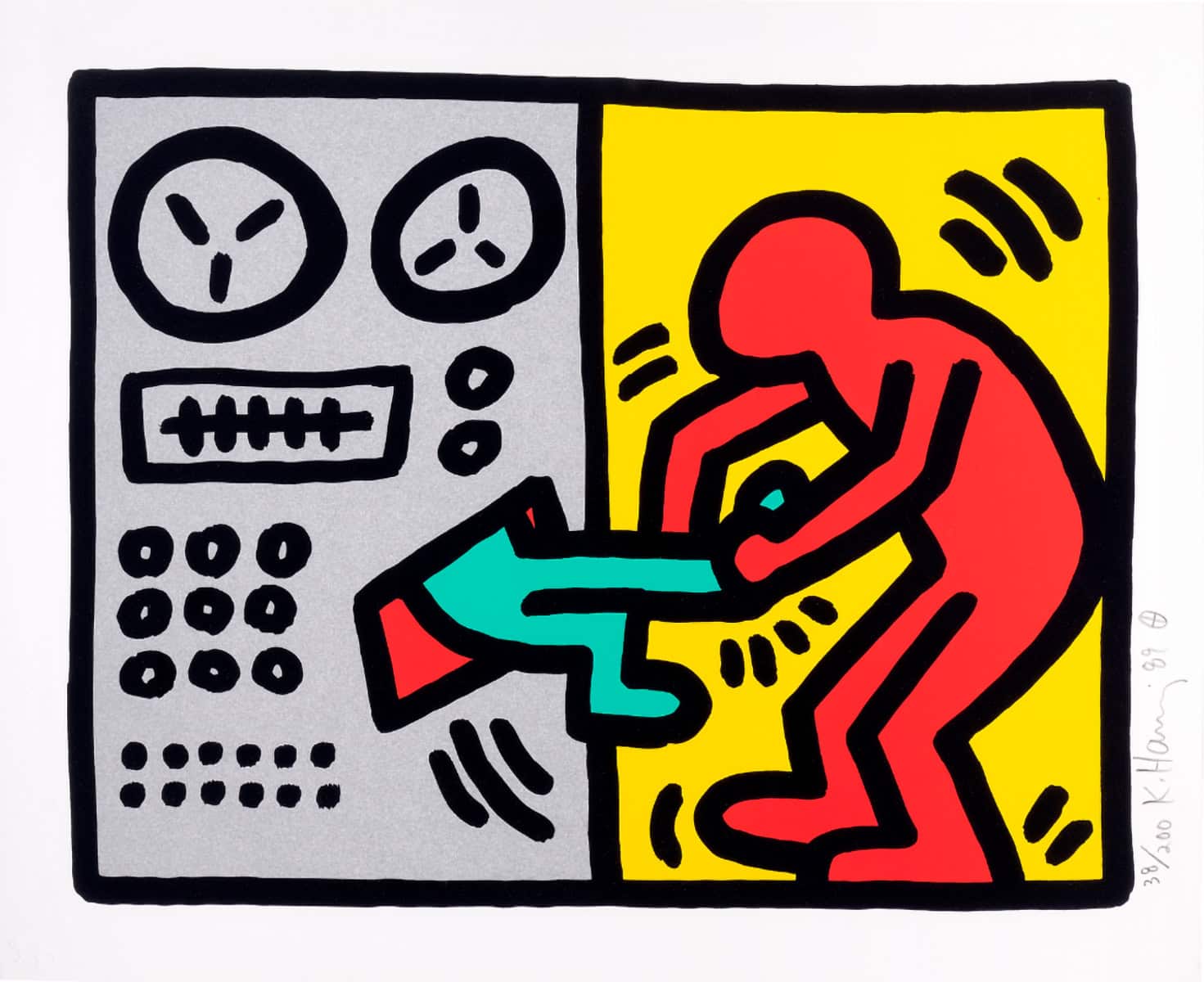


Pop Shop IV — 1989
Pop Shop IV features red, yellow and orange compositions with human figures and familiar Haring motifs, including dogs and the radiant baby. Identify which of the four images you own. The regular portfolio and the larger Pop Shop Quad IV have different formats and certification histories.
Format: Four separate screenprints, generally on sheets around 13½ × 16½ inches.
Edition: 200 numbered impressions per image, plus proofs.
Markings: Regular portfolio impressions are generally signed by Haring in pencil.
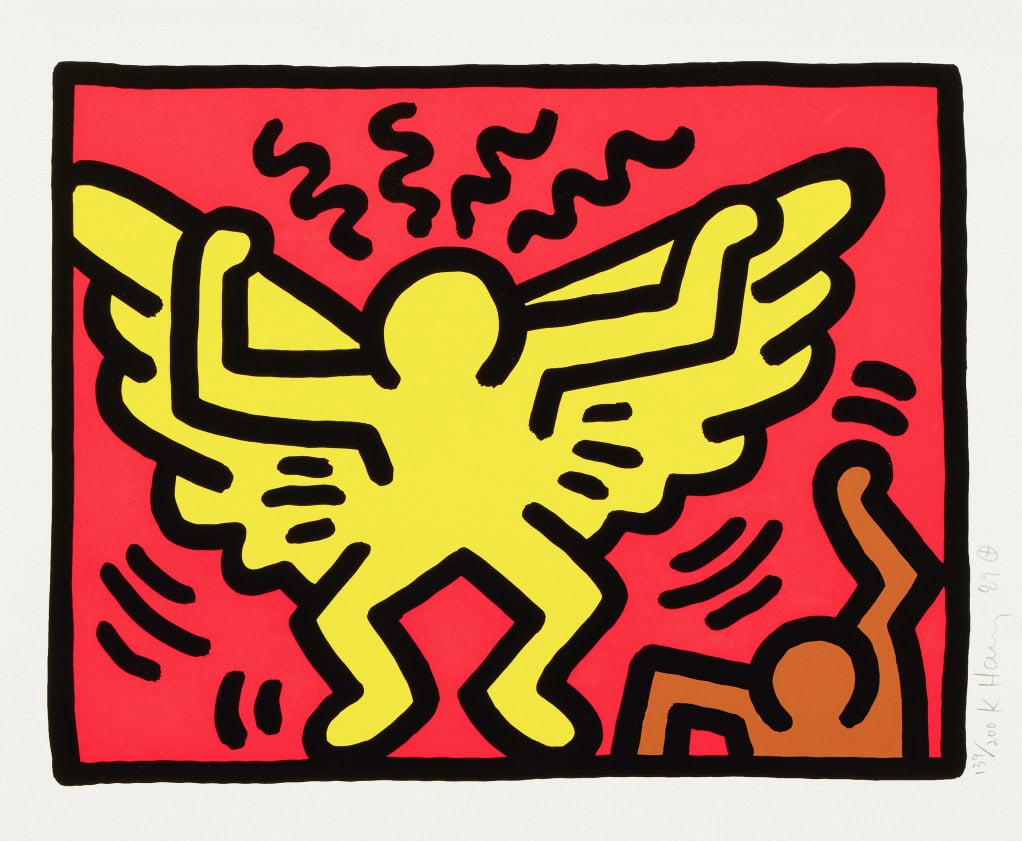


Pop Shop V — 1989 designs
Human and marine figures interact across pink, orange, violet and blue compositions in Pop Shop V. Although the imagery dates to 1989, documented editions were issued later and carry estate certification. The reverse markings are therefore an important part of identifying the specific impression.
Format: Four separate screenprints, generally on sheets around 13½ × 16½ inches.
Edition: 200 numbered impressions per image, plus proofs.
Markings: Documented editions have an estate stamp signed by Julia Gruen on the reverse.


Pop Shop VI — 1989 designs
The final numbered portfolio explores joined and interlocking human figures, including a composition in which five figures form the fingers of a hand. Its four screenprints belong to numbered editions of 200, plus proofs, and generally use sheets around 13½ × 16½ inches.
As with Pop Shop V, documented editions carry certification on the reverse signed by estate executor Julia Gruen. Published descriptions can show both the 1989 design date and a later edition or certification date. Photograph those details exactly as they appear.


A work may be described as Untitled, by a plate number or by its subject. We match the composition and edition against Klaus Littmann’s Keith Haring: Editions on Paper 1982–1990 and supporting records. For a complete portfolio, send photographs of all four sheets and their individual markings.
Editions, Signatures and Estate Markings
Hand-signed Pop Shop I–IV
The regular Pop Shop I–IV editions are generally signed, dated and numbered by Haring in pencil. Photograph every inscription, including the edition fraction and any proof designation. Additional proof editions exist, and their counts vary; the information for one portfolio should not be applied to every Pop Shop screenprint.
Estate-certified Pop Shop V and VI
Pop Shop V and VI require a different signature check. Documented editions use Haring’s 1989 designs but were issued after his death. Examples carry an estate stamp on the reverse, signed and dated by estate executor Julia Gruen, with numbering and an Iguana blindstamp.
The executor’s certification is distinct from Haring’s own autograph. Preserve photographs of the entire reverse and the exact certification date. Published records include Pop Shop V dated 1989/1994 and Pop Shop VI dated 1989/1995.
Pop Shop Quad: four images on one sheet
A Quad combines four compositions on a larger single sheet. A portfolio contains four separate sheets. Quad editions can have different edition sizes and certification: a documented Pop Shop Quad IV is estate-certified and numbered from an edition of 75, with 15 artist’s proofs. Identify the precise Quad before comparing it with smaller screenprints.
For information about screenprint values, read How Much Is My Keith Haring Worth?
Documenting a complete portfolio
A complete suite contains the four compositions belonging to one numbered Pop Shop series. Record each sheet separately, including its edition number and condition. Matching numbers, original folders and publication materials help describe a set accurately. Mixed edition numbers or missing materials should also be recorded when assessing the portfolio as a whole.
How to Sell Your Keith Haring Pop Shop Screenprint
- Send photographs. Include the front, back, signature, numbering, estate stamp, blindstamps and labels. Add sheet dimensions and any purchase records.
- Review our evaluation. We research the portfolio, edition, condition, provenance and relevant market comparisons.
- Discuss a potential offer. If the work suits our inventory, we can discuss direct purchase. Once terms are agreed, we coordinate payment and appropriate collection arrangements.
Frequently Asked Questions
Can I sell a single Pop Shop screenprint?
Yes. We consider individual screenprints as well as complete portfolios and Quad editions. Send the image and markings even if you do not know the portfolio number.
Does every original Pop Shop screenprint have Haring’s signature?
No. Documented Pop Shop V and VI editions have estate certification on the reverse. The correct markings depend on the specific edition and format.
Is a Pop Shop poster the same as an editioned screenprint?
Posters and licensed merchandise have their own production histories. Identifying a numbered fine-art edition requires checking the printing, paper, dimensions, inscriptions and catalogue documentation.
Do I need all the original paperwork?
Existing invoices and certificates can help, but you can begin with photographs and whatever information you have. Include any previous ownership or exhibition history you know.
Request a Free Pop Shop Valuation
Our gallery offers a free, confidential valuation of Keith Haring Pop Shop screenprints, portfolios and Quad editions. Submit photographs of your artwork and its markings using the form below.
If the work is suitable for our inventory, we can discuss a potential direct purchase offer. Further examination may be needed before an offer is confirmed. There is no obligation to sell.